Showing posts with label photography. Show all posts

February 08, 2017

Exploring Historical Buffalo, New York

                                    (The Swannie House, Buffalo NY/Image copyright of Lieuxabandonnes)

I hopped on a Greyhound bus on Thanksgiving Day and headed to Buffalo NY. As it turns out, traveling the US on Thanksgiving isn't recommended; finding a meal or even snack is near impossible. One of my greatest memories of this trip was the hospitality and generosity of the bus driver who shared his thanksgiving meal with me. This was my final lasting impression of what it means to be an American before I headed home to Canada.The six days I spent in Buffalo would be my final photographic exploration of the USA, and it was a memorable visit to say the least.

I had some locations in mind to explore, but as it turned out, local advice changed my mind about where I'd actually explore. I stayed at the Buffalo Hostel and met three photographers who were exploring that week. I have to say that really was a bonus to have inside information ie routes of travel and so on. One of the photographers was a seasoned expert about the historical grain elevators of Buffalo NY and even offered to take me along and go down the elevator shoots together. Teach me the ropes, if you will.

I ended up declining after mulling this over a few days because I follow my intuition, and the thought of not having the physical strength to pull myself back up once down didn't seem terribly appealing ... maybe if I was 20 years younger ... As it turned out, intuition is best. A month later an injury from previous months manifested in Canada, whereby my neck and spine collapsed and was paralyzed for almost a year down my left side of my body. Due to my injuries, I'm very cautious about exploring, and as you know, while it doesn't happen often, some explorers have perished in unsafe buildings.


What remains memorable to me are the unintended discoveries along my route, like stumbling upon an abandoned fuel station called Sam's. That's a first. I've never seen so many American flags in any city, nearly every image has a flag somewhere. Up the road at the corner of Ohio and Michigan I stepped into the Swannie House for some downright good tender vittles and washed it down with a beer. Several hours of a constant drizzle of rain in late November left me cold to the bone, so stepping into the historical Swannie House wrapped up my visit to Buffalo in such a positive note.

The staff were super friendly, so I lingered at Swannie's listening to local history. I pulled myself away as I had a bus to catch in a few hours back to Canada. I stepped out the door into the cold rain on Ohio and made my way back to the hostel, threw my damp clothes into a dryer and said my final farewells to Buffalo NY.


                              (Old Hardie Kentucky Straight Whiskey/Images copyright of Lieuxabandonnes)


September 13, 2011

A Peek into Asylum: One Photographer's Perspective of the Interior World of Mental Asylums

 
(Photographer: Christopher Payne. Title: File Boxes)

If you love the idea of photographing abandoned buildings and institutions, yet don't like the idea of trespassing on private property, you might like the way Christopher Payne went about photographing 70 mental hospitals across 30 states between the years of 2002 to 2008. Christopher Payne, photographer and architect, was given open access to visit and document the history of the American asylum in his newest book, Asylum: Inside the Closed World of State Mental Hospitals. We peek into Payne's perspective about the interior world of mental asylums from a photographer's (and architect's) point-of-view.

"We tend to think of mental hospitals as “snake pits”—places of nightmarish squalor and abuse—and this is how they have been portrayed in books and film. Few Americans, however, realize these institutions were once monuments of civic pride, built with noble intentions by leading architects and physicians, who envisioned the asylums as places of refuge, therapy, and healing." 
 (Excerpt: Asylum Project Statement)

Take Nothing but Photographs, Leave Nothing but Footprints

If you've ever read any of our past article posts regarding our views about trespassing or breaking and entering, then you know we don't agree with a sub-group of certain explorers these days. There are at least two other methods of gaining access to a building. One is express permission as Payne's six-year project clearly illustrates, and we like how his creative project exemplifies how gaining access to non-accessible institutions through legitimate routes benefits the documentation of abandoned institutions before they are demolished forever.

Another method of exploration is to visit one of the many hospitals and prisons that are open to the public. I've heard explorers suggest these are less exciting alternatives; well, all I have to say about that is they need to figure out why they're doing what they're doing and why they're effectively ruining it for the rest of us. It seems to me photographers and historians do less damage in buildings, are less interested in the hype about infilteration, thus follow urban explorations golden rule:

"Take nothing but photographs, leave nothing but footprints."

There are times when someone needs to tread softly and go through an already open door (Note: That does not mean pick a lock or kick the door down ... ), but those moments are only known by the faint footprints left behind. The footprints left behind do not need to be published all over the web inviting vandalism and thrill seekers. This is why there is such heavy security these days at many of the remaining locations not yet demolished - at least in our humble opinion.

Copyright and Permissions

Photographers that trespass also need to keep in mind that without express permission from the owners, your published photography, or even photographs entered into photography contests could be forfeited without the proper permissions from the owners of the property.

A Photographer's Approach

Granted, it could take years to gain permission to enter and photograph some of these decaying institutions, but that holds a particular excitement on its own. Furthermore, Payne was able to photograph some off-limits buildings that housed residents, meaning the buildings were not yet vandalized, nor looted and stripped of their interiors and artifacts. This fact actually makes Payne's photographs of particular interest. In context, this lends to his work an engaging mixture of sweeping interior landscape and still life. A few of my favorite photographs from Payne's collection are 'Patient Toothbrushes' taken at Hudson River State Hospital, 'Hair Salon' at Trenton State Hospital, 'Unclaimed Cremation Remains' at Oregon State Hospital, 'Patient Suitcases' at Bolivar State Hospital, 'File Boxes' at Spring Grove State Hospital and 'Bowling Shoes' at Rockland State Hospital.

Technique: Use of Light, Space and Minimalism

Another aspect of Payne's Asylum collection I like is his minimalist approach. In fact, I prefer to see images of asylums that are clean, bright, simple and elegant. In fact, many of Payne's images run counter-intuitive to the mainstream urban exploration crowd. Sometimes when I'm viewing the dark, shadowed images common to urban exploration, I simply wish I could see the details of an image in the light of daylight. Maybe my age is telling in itself, but if I have to squint that much to see a darkened image I am finding it not worth my time more and more these days. It's simply a matter of taste and style, but I've really enjoyed the use of light, space and minimalism of Payne's Asylum project. If you're interested in viewing a sample of images published in the book Asylum, you can view the slideshow here.

If you're interested in viewing Payne's projects, you may visit his website here. I also enjoyed his project listed under North Brother Island, in New York. Christopher Payne also has more upcoming gallery exhibits in 2012-2013 in Belgium, Netherlands and Italy.

November 03, 2009

Gothic Prison Architecture


Admin Circular Door:

Part of the oldest sections/Gothic structure at WV Penitentiary, which includes the older high security cell units as well. The door straight away is a beautiful Gothic style circular door that admitted new inmates into the penitentiary. This circular door is classic, and will not be seen in new prison architect. Once behind this door, there is no way out. Or perhaps it's better to say once behind this door, you are on your own ...


All Material in this Photo Blog Gallery is Copyrighted & May not be reproduced, copied, edited, published, transmitted or uploaded in any way without my permission. All Rights Reserved.

November 02, 2009

Prisoner Art & the Paranormal


The painting on the wall was created by a prisoner at WV Penitentiary, in memory of the woman he murdered. If you're familiar with the 'shadow man' at WV Penitentiary - TAPS recently debunked the photos (possibly erroneously) - the shadowy apparition has been sighted and captured in this newer cafeteria, as well as the hallway between it and the older cafeteria. Various individuals have captured images of likeness to the original shadow man images at different times, daylight and midnight, and locations. I found this wall art spookier in a
real way far more than the possibility of seeing the 'shadow man.'


All Material in this Photo Blog Gallery is Copyrighted & May not be reproduced, copied, edited, published, transmitted or uploaded in any way without my permission.


All Rights Reserved.

October 26, 2009

Waiting for the Mail


I seen this wonderful kitty yesterday just lounging on this rural mail box - I couldn't resist adding a slight hint of a postcard texture. This adorable foto put a big smile on my face! Tomorrow, back to the blog theme of darker and peeling things...
All Material in this Photo Blog Gallery is Copyrighted & May not be reproduced, copied, edited, published, transmitted or uploaded in any way without my permission.


All Rights Reserved.

September 30, 2009

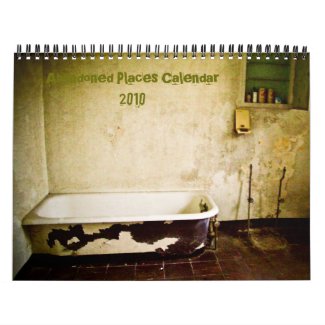
The New Abandoned Places Calendar-2010

I started creating a new 2010 calendar for Abandoned Places, which I'm fairly excited with! One thing lead to another, and I started playing around with a few other gift ideas emphasizing the abandoned places photos. I guess we now have a new abandoned places gift store online, so please come and visit and share your thoughts! Cheers

September 17, 2009

Documenting Time: Abandoned Vehicle


These were captured in the season of winter, while I continue to document time with the same subject through the seasons. There's certainly a different perspective illuminated this round in comparison to summer or fall captures.

Snow can be a natural unifier in photos, and winter light usually elucidates a stark landscape due to the low angle of the sun. While the winter light and snow produce obstacles and undesired qualities at times, winter light also reveals deeper textures and soft hues amidst long shadows often associated with the winter light.

Winter light is indeed one of my favorite light sources. Fall is also one of my favorite light sources with all of it's red hues as the days shorten, mirroring the dramatic changes happening in the fading foliage.

Thus, I grouped my fall (early fall/late summer) collection of the abandoned car as the 'Eye of the Storm'. I may group this winter set as Fade to White, or Fade to Winter Light.


All Material in this Photo Blog Gallery is Copyrighted & May not be reproduced, copied, edited, published, transmitted or uploaded in any way without my permission.
All Rights Reserved.

September 16, 2009

Documenting Time

We're recording a slice of time each time we photograph a moment. Photographers have the ability to suspend a moment in time.

Many moments can never be captured again, and it's necessary to capture split seconds. Expressions of the human face, for instance, are fleeting seconds. Recording time can also be the moments of capturing the speed of the subject, or stopping the clock in a timeless scenery.

Documentary photographers are recording time. Moments of civil upheaval demand quick reflexes. Urban street photography requires a photographer's wits about them.

Urban photographers capturing the final remnants of abandoned places have little time in most cases, on location, and in the likelihood the structure may be removed at any time.

But recording time can be as unassuming as capturing the seasons and the hours of shifting light. It is true that time never stops providing the photographer with endless change all around them, even in the simplest, humblest moments and subjects.

Humble moments taken close to home can make some of the best photography. Many of these moments allow the photographer time to revisit the subject multiple times rendering a new perspective each and every visit.

You can never take enough captures. Capturing the same image over extended periods of time through the seasons, years, or changes in lighting allows the photographer to grow intimate with the subject and discover something new each time.

My abandoned car photographs are just this premise, visiting in the change of seasons.


All Material in this Photo Blog Gallery is Copyrighted & May not be reproduced, copied, edited, published, transmitted or uploaded in any way without my permission.
All Rights Reserved.
MyFreeCopyright.com Registered & Protected
Photographers deal in things which are continually vanishing and when they have vanished there is no contrivance on earth which can make them come back again.
-Henri Cartier-Bresson-

Public Commons

We see the beauty in decay and the shadowed dreams of the forgotten.